

Erasmus+ Partnerships for Cooperation
The European Union programme Erasmus+ funds education, training and youth Partnership projects in organisations across Europe as part of Key Action 2. This funding is to help increase the quality and relevance of their activities, to develop networks, to boost internationalisation and to transfer innovative practices. Partnership projects should produce results and learning that are re-usable, transferable, and that can be scaled up.
There are two types of Erasmus+ Partnership project, Cooperation Partnerships and Small-scale Partnerships. This page explains how an organisation can use Partnership projects and how to get involved. You can then sign up to our mailing list or come to an information session to find out more.
If you want to apply for funding, you will need to be familiar with the Erasmus+ priorities. You will also need to read the Key Action 2 section of the Erasmus+ Programme Guide to understand the programme rules.
And remember, some of the terms we use can seem overwhelming at first, so check out our Jargonbuster page for a handy glossary!
What is a Partnership Project?
A partnership project is where an organisation works with other relevant groups in different countries to exchange ideas or to develop, transfer or implement innovative practices. Funding is available for Irish organisations, institutions, companies, and research organisations that are active in Adult Education, School Education, VET or Youth. The project should address at least one of the Erasmus+ priorities.
Who Can Take Part in a Partnership Project?
There are two types of partnership project:
- Cooperation Partnerships
- Small-scale Partnerships
Cooperation Partnerships are suitable for experienced organisations or larger-scale projects. Small-scale Partnerships have shorter durations and simpler administration. They are ideal for grassroots organisations or newcomers to Erasmus+.
Any public or private organisation established in an Erasmus+ Programme Country can apply.
What Happens in a Partnership Project?
Partnership projects help organisations to:
- Increase quality in their work, activities or practices
- Build capacity to work transnationally and across sectors
- Address common needs and priorities in education, training and youth
- Enable transformation and change, leading to improvements and new approaches at individual, organisational or sectoral level.
A partnership project could be:
- An Adult Education organisation working with expert organisations to develop an innovative training course
- A school working with other schools to develop its approach to digital learning.
What is the Funding for a Partnership Project?
Erasmus+ funding can be used for:
- Project management and implementation – for preparing and carrying out the project
- Learning and training activities – to support project implementation
- Meetings and events – e.g. workshops to exchange practice or develop results
- Project deliverables – producing results or outcomes
- Sharing and promotion activities – aimed at sharing the project’s results
There are set lump sum amounts for a Partnership project which contribute to the cost of eligible activities linked to the implementation of the project. You can choose between the pre-defined amounts according to the activities you wish to undertake and the results you wish to achieve. The pre-defined amounts are €400,000, €250,000 or €120,000 for a Cooperation Partnership and €60,000 and €30,000 for a Small-Scale Partnership.
How Do We Set Up a Project?
All Partnership projects have four stages, that you must outline clearly in your application.
- Planning – Define the needs, objectives, activities, outcomes and schedule
- Preparation – Plan the activities, develop the work programme and practical arrangements, formalise agreements with partners
- Implementation – Carry out the activities
- Follow-up – Evaluate the impact, share and encourage use of the project results.
What Happens Next?
Once the project is planned, the organisation can submit an online application before the deadline. The application requires a lot of detail and organisations should allocate at least six weeks to plan and write it.
Léargas evaluate applications using strict Erasmus+ criteria. We contact applicants with our decision three months after the deadline. If your project is funded, the organisation receives a large proportion of the funding at the start of the project. The organisation then carries out the project and submits a Final Report on its progress. The remainder of the funding is paid when this Final Report is approved.
Read our section on Applying for Erasmus+ Partnerships for more detail on the application process.

Partnerships for Cooperation Resources
-
Handbook on the Lump Sum Funding Model for KA2 Partnerships 2023 Applications
Handbook, 2023
-
Mythbusting: European Project Management in Transnational Partnership Projects, 2020
A Handbook for European Project Managers by European Project Managers
-
Organisation ID Guide for Erasmus+ and the European Solidarity Corps
Guidelines, 2021
-
Roadmap to Erasmus+ Partnerships for Cooperation Funding
Erasmus+ Partnerships for Cooperation Funding Roadmap

Key Events

European Conference “Schools in Times of Transition: Well-Being and Social Cohesion in a Changing Europe”
Newcomers and experienced beneficiaries come together to explore how Erasmus+ and eTwinning can strengthen well-being, resilience and social cohesion in schools amid a changing Europe.

Demystifying Erasmus+ VET Mobility Projects
Joins us for a discussion on how community and voluntary organisations can benefit from participating in Erasmus+ Mobility projects.

Fostering Lifelong Learning Through Peer Exchange: Erasmus+ Mobility Projects
Joins us for a discussion on how community and voluntary organisations can benefit from participating in Erasmus+ Mobility projects.

From Idea to Impact – An Erasmus+ Youth and European Solidarity Corps Project Lab for Deaf and hard-of-hearing people and organisations
Do you have a youth project idea and want Erasmus+ or ESC funding? Get support to develop it, choose the right format, and meaningfully involve Deaf or hard-of-hearing people.

Erasmus+ Sport Staff Mobility Information session
Join our online Erasmus+ Sport Staff Mobility information session to learn about KA182 funding, eligibility, and how to prepare a strong application.

Erasmus+ Sport Staff Mobility Information session
Join our online Erasmus+ Sport Staff Mobility information session to learn about KA182 funding, eligibility, and how to prepare a strong application.
Partnerships for Cooperation Links

Latest Erasmus+ News
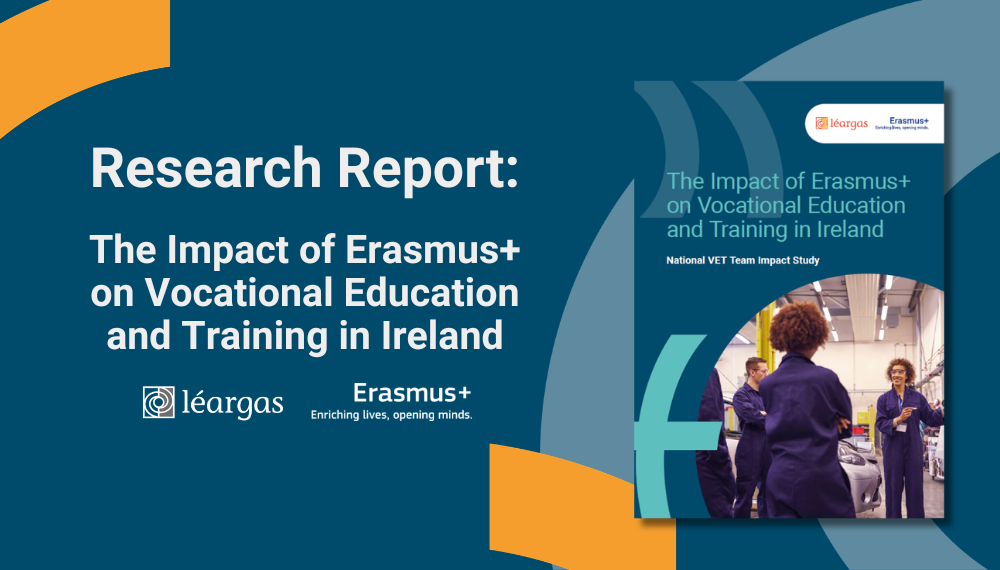
Research Launch: The Impact of Erasmus+ on Vocational Education and Training in Ireland
Léargas is pleased to announce the publication of its latest research report, “The Impact of Erasmus+ on Vocational Education and Training in Ireland”.